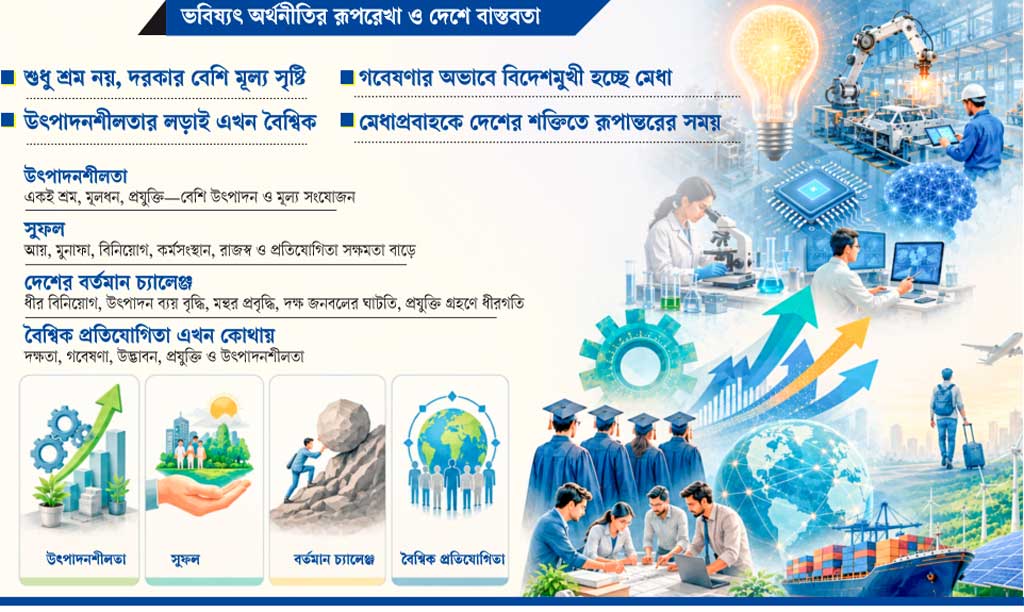
Bangladesh’s biggest economic test now lies in raising productivity—producing more with the same labour, machinery and capital—as slower investment, rising production costs and weaker growth sharpen pressure to generate greater output from existing resources.
The OECD’s Compendium of Productivity Indicators 2025 says productivity is the biggest long-term driver of economic development and living standards. The Asian Productivity Organization’s Productivity Databook 2025 similarly says the quality of labour and the ability to create greater value from the same resources are becoming increasingly important for long-term growth across Asian economies.
Research and analysis by Professor Dr Selim Raihan, executive director of the South Asian Network on Economic Modeling, point to the same conclusion. Selim Raihan says productivity does not depend only on workers’ skills; its foundation is built through a combination of education, technology, innovation and effective institutions.
Recent economic conditions in Bangladesh have made that need more visible. With investment slowing, production costs rising and growth weakening, the central question is how to ensure more output from existing resources.
The productivity challenge is no longer confined to factory floors; it has spread into a global contest for talent and knowledge. Advanced economies are increasing investment in high-tech industries, research and innovation while attracting skilled professionals from around the world. As a result, skilled human resources have become a key foundation of economic capacity and competitiveness.
Bangladesh is also part of that global trend. A portion of the country’s highly educated and skilled professionals—including scientists, researchers, engineers, doctors, software engineers, artificial intelligence specialists, data scientists, economists, university teachers, architects and innovators—are joining labour markets in developed countries. That means part of Bangladesh’s investment in building human capital is being utilised abroad.
After graduating in computer science and engineering from Bangladesh University of Engineering and Technology, research engineer Siam Ahmed moved to Canada in 2021 for higher studies. Siam Ahmed now works as a research engineer at a Toronto-based artificial intelligence company. Speaking over a WhatsApp voice call, Siam Ahmed said he would like to return to work in Bangladesh, but limited research funding, the lack of modern laboratories and weak prospects for a long-term research career discourage him.
“It is not just about salary. For a researcher, the biggest consideration is the environment needed to implement one’s skills and ideas,” Siam Ahmed said.
According to the United Nations Department of Economic and Social Affairs’ International Migrant Stock 2024, more than 8.7 million Bangladesh-born people are living in different countries around the world. Government budget documents for fiscal year 2026-27 say there are currently around 10 million Bangladeshi workers and expatriates abroad. OECD data show that the number of Bangladesh-born migrants in the United States, United Kingdom, Canada and Italy rose from 737,000 in 2020 to 915,000 in 2024.
The trend points not only to rising migration but also to growing global demand for highly skilled workers. Data from the Bureau of Manpower Employment and Training show that of the 1.13 million workers who went abroad in 2025, 237,000 were skilled workers and 45,000 were professionals.
A similar pattern is visible in overseas higher education. Data from the UNESCO Institute for Statistics show that 52,799 Bangladeshi students were enrolled in higher education in different countries in 2023. Md Zulfikar Ali Jewel, president of FAD-CAB, an association of overseas higher education admission counselling institutions, said 70,000 to 80,000 students go abroad every year and at least 60 percent of them do not return to Bangladesh.
Experts, however, say international migration of skilled people should not be seen only as a loss. The key issue is how much of the knowledge, technological capability and professional experience gained abroad can be connected to Bangladesh’s industry, production and economy.
Dr Tasneem Siddiqui, executive director of the Refugee and Migratory Movements Research Unit, told Ajker Patrika: “The global mobility of skilled people is now a reality. The challenge is to create an environment in which the knowledge, experience and capabilities gained abroad can become part of the country’s development. The state must ensure that.”
The experiences of South Korea, Singapore, China and India are cited by experts as notable in turning skilled manpower into a force for productivity. Those countries have not only developed skilled people but also linked the knowledge, technology and global networks of researchers, engineers, scientists and entrepreneurs living abroad with industry, research and innovation at home. In the era of global talent flows, successful countries have focused more on transforming talent into national productivity than on trying to stop people from moving.
Productivity is therefore not just about increasing profits for an individual enterprise; its effects spread across the wider economy. If more value can be created with the same labour and capital, industrial competitiveness rises, incomes increase, investment capacity expands and the long-term foundations of the economy become stronger.
Tax expert and former National Board of Revenue chairman Dr Muhammad Abdul Mazid told Ajker Patrika: “A highly productive economy or individual does not simply mean more output; it means generating more income from the same resources. The benefits are reflected in employment, investment and state revenue.”
The government also sees productivity growth as one of the main models of economic transformation. Finance Minister Amir Khasru Mahmud Chowdhury said: “Skilled manpower is the country’s greatest asset. The government is therefore giving priority to expanding opportunities in technology-based industries, research and innovation, alongside international-standard skills development and quality employment, so that skilled professionals can realise their potential at home.”
Bangladesh’s new development equation now rests there. The future of the economy will depend not only on the rate of growth, but on how much productivity is generated within that growth. In the next decade’s economic competition, the country’s biggest test will be who can create more value using the same labour, capital and resources.