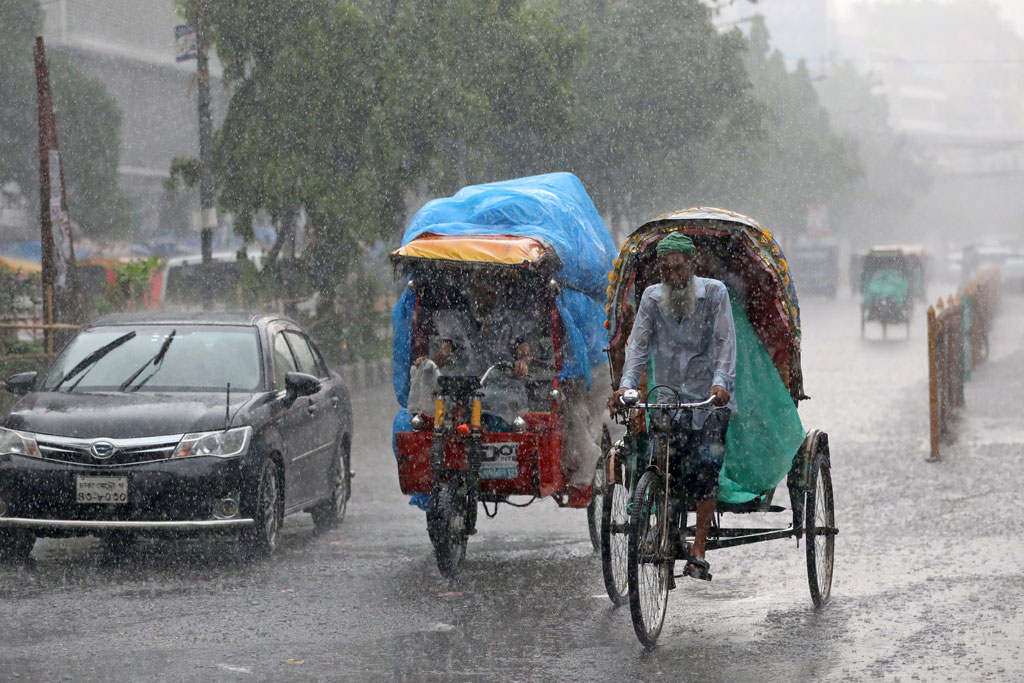
Air pollution breaches safety limits nationwide
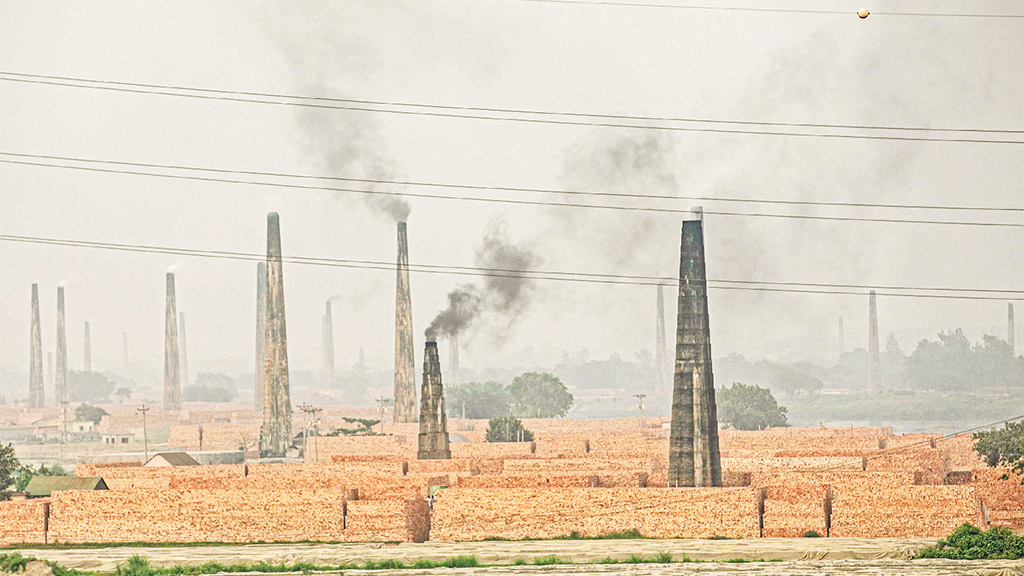
Air pollution in Dhaka and major cities across Bangladesh remained at alarming levels from January to June, with harmful particulate matter repeatedly exceeding national safety limits, according to Department of Environment monitoring reports.
Analysis of the department’s air-quality data for the first six months of the year showed that PM2.5 or PM10 concentrations exceeded national standards in at least one city throughout the period.
Under Bangladesh’s Air Pollution Control Rules, the 24-hour national standard for PM2.5 is 65 micrograms per cubic metre, while the limit for PM10 is 150 micrograms per cubic metre. Average PM2.5 levels over the six months were four to six times the acceptable national limit, while average PM10 levels were more than double the standard.
Department of Environment data indicate that air pollution is no longer confined to the capital or a few metropolitan cities. Harmful particle concentrations exceeded national safety limits in divisional cities, industrial areas, district towns and upazilas. Some areas experienced polluted air for several days, while others remained polluted throughout entire months.
The reports showed that pollution levels and geographic spread varied during the six-month period, but the overall crisis persisted. Conditions improved slightly in several regions in March, although severe pollution was recorded in January, February and May.
Dhaka, Savar, Gazipur, Cumilla, Narayanganj, Chattogram, Khulna, Barishal, Mymensingh and Rangpur were among the areas where airborne particle levels reached alarming levels. PM2.5 and PM10 concentrations repeatedly exceeded safe limits for prolonged periods.
Station-based data from January to June showed that PM2.5 or PM10 exceeded national standards on 1,152 of 2,476 station-days recorded across 16 monitoring stations. Pollution was therefore above the prescribed limit on nearly 50% of all observed station-days.
The Department of Environment regularly measures pollution through 31 continuous air-quality monitoring stations in divisional and industrial areas. The stations monitor PM10, PM2.5, ozone, sulphur dioxide, nitrogen oxides and carbon monoxide.
The most serious warning in the six-month data concerned PM2.5. Narayanganj recorded a PM2.5 concentration of 387 micrograms in January, nearly six times the national standard and described as a hazardous minimum level of air pollution.
Narayanganj’s highest PM10 concentration during the same period was 523.1 micrograms, more than three-and-a-half times the national limit. Pollution levels at stations in Agargaon and Darus Salam in Dhaka, as well as Gazipur, Chattogram, Rajshahi, Cumilla, Khulna and Narsingdi, were two to six times above national standards.
Average concentrations declined somewhat in March, but the number of areas with pollution above national limits did not fall. Average PM2.5 levels were 106.9 micrograms in Gazipur, 99.1 in Mymensingh, 98.8 at Dhaka’s BARC station and 95.1 in Cumilla.
Average PM10 levels in March were 230.9 micrograms at Agrabad in Chattogram, 206.2 in Mymensingh, 175.8 in Rangpur and 168 in Rajshahi.
Monitoring data also showed that air pollution was nearly constant in several areas, with air quality in some locations failing to fall below national limits on any day of particular months.
PM10 levels exceeded the national limit on all 31 days of January in Narayanganj, Khulna and Rajshahi. PM2.5 levels remained above prescribed standards throughout all 28 days of February at the Department of Environment station in Dhaka, Rajshahi, Cumilla, Chattogram TV Station, Mymensingh and Gazipur.
PM2.5 levels exceeded limits for 21 days at Dhaka’s BARC station in March, for 20 days each in Cumilla and Rajshahi, and for 18 days at two Chattogram stations and in Mymensingh.
Narayanganj’s average PM10 level in May was 334.9 micrograms, more than twice the national standard. PM10 exceeded the limit in Narayanganj on all 31 days of the month, while PM2.5 levels in Cumilla remained above the acceptable national level every day.
The government adopted a National Air Quality Management Plan for 2024-2030, identifying major pollution sources and assigning responsibilities to relevant agencies. Statistics and experts, however, said the results of the initiative were not yet visible.
Between July 2025 and June 2026, authorities conducted 500 mobile court operations against illegal brick kilns. The drives resulted in 1,157 cases, fines totalling Tk 238.641 million and the closure of 258 brick kilns.
Authorities also conducted 29 drives against lead and battery-smelting factories during the same period, filing 36 cases and collecting Tk 4.04 million in fines. Operations at 23 factories were shut down, although there have been allegations that some resumed operations due to inadequate monitoring.
A further 230 mobile court operations were conducted to control dust from uncovered construction materials, resulting in 421 cases. Guidelines require contractors, responsible officials or institutions to be held accountable when construction, excavation or development work causes pollution. Pollution levels have nevertheless not declined.
Chest disease specialist and Bangladesh Lung Foundation Joint Secretary Kazi Saifuddin Bennur told Ajker Patrika that PM2.5 and PM10 are among the most harmful components of air pollution.
“Relatively larger particles may become trapped in the upper respiratory tract, but fine particles enter deep into the lungs and disrupt the normal exchange of oxygen and carbon dioxide,” he said. “Toxic components in polluted air, including sulphur, nitrogen, carbon monoxide and lead, damage the lungs and worsen diseases such as asthma and COPD.”
Kazi Saifuddin Bennur said lead was especially harmful to children, as airborne lead particles can obstruct brain development and reduce intellectual capacity.
Muhammad Solaiman Haider, Additional Director General of the Department of Environment, said pollution levels rise in Dhaka and other major cities during the dry season.
“During winter, pollution is generated by brick burning at more than 7,000 brick kilns, dust from infrastructure construction, burning of firewood, timber and crop residues, and municipal waste,” he told Ajker Patrika. “The government has taken various measures to control these sources.”
Professor Dr Ahmad Kamruzzaman Majumder, chairman of the Centre for Atmospheric Pollution Studies and a professor at Stamford University Bangladesh, expressed concern and surprise at the pollution levels recorded in the government report.
“The sources of air pollution are known to all of us. Brick kilns, vehicles, industrial factories, construction work and waste burning have all been identified,” he said. “But there is a lack of effective action and enforcement to control these sources.”
Professor Kamruzzaman said laws existed to protect people from air pollution but were not being followed. He said nine High Court directives issued since 2019 to stop unfit vehicles had not been properly implemented.
“The first step in controlling pollution is to understand the nature and sources of pollution,” he said. “However, there are shortcomings in taking necessary action after monitoring.”
Professor Kamruzzaman said priority should now be given to implementation and enforcement. He called for increased budget allocations, capacity and manpower for the Department of Environment, and said air-quality monitoring stations were needed in every district and upazila town.