

Is Bangladesh ready for the AI job market
Over the course of history, Homo sapiens adapted to climate bottlenecks, ice ages, and ecological shifts. We defeated monsters hundred times stronger than us. We have packed the game so far, and now we are here: facing our self-created clone—artificial intelligence (AI). How do we wrap it? By shutting down our replica or taking a smart advantage of it? That’s a million-dollar question.
AI is no longer a threat to the first world’s white-collar color jobs alone. It is disseminating a constant fear among third-world countries like Bangladesh too. Many young Bangladeshi fresh graduates are getting paranoid when AI is thrown on their table. But if they are cunning enough, they can take advantage of it and put Bangladesh’s developing economy in a far better position. But this is not going to be a child’s play for them.
Bangladesh’s economy has long relied on blue-collar jobs like the ready-made garments industry, agriculture, and foreign remittances. But now, it’s facing a new challenge that it never imagined. AI is going to be a slow poison if the industry fails to adapt to it.
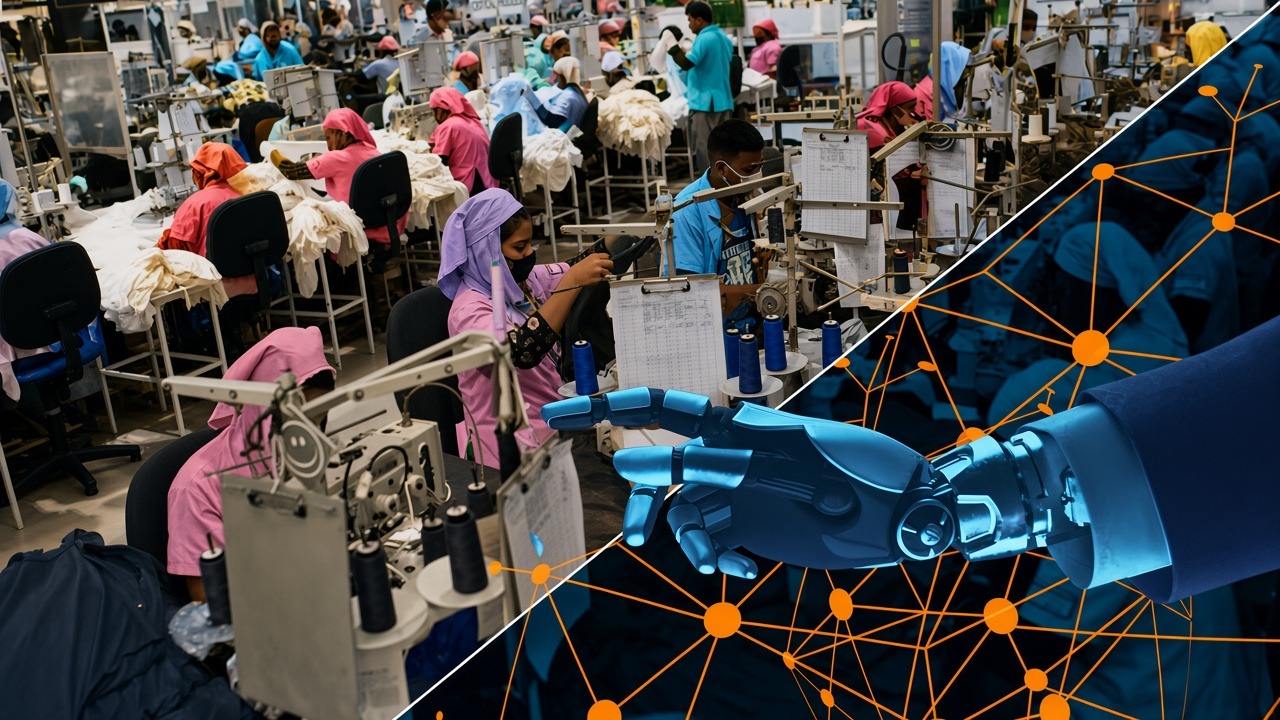
In this critical crossroads, economists, researchers, and industry leaders are suggesting one certain thing: we must create high-value employment as AI robots are about to take away all those blue-collar jobs. They are already being trained on how to sew and fold garments.
Lately, a prominent Bangladeshi economist Debapriya Bhattacharya warned artificial intelligence, robotics, and rapid technological shifts could eliminate as many as 5.6 million jobs in the country. That’s a nightmare for those poor lives.
According to studies by labor foundations and research organizations, automation and digital planning tools are reducing human labor in cutting floors, clerical duties, data entry, and basic customer services. In the ready-made garments sector, which employs approximately four million workers—while the lion's share are women—automated cutting machines, robotic sewing setups, and AI-driven pattern-making software are steadily shrinking entry-level and helper roles.
However, if we can brush aside the automation threat, AI can turn into an engine for job creation. It can help create entirely new economic paradigms. AI-driven design, quality control, and predictive analytics can reduce factory waste and increase efficiency. Similarly, AI-run mobile apps can diagnose crop diseases and multiply agricultural productivity.
The global shift toward data-driven systems has generated surging demand for specialized professionals skilled in data analytics, machine learning engineering, algorithmic auditing, cloud management, and cybersecurity. In Bangladesh, where a vibrant network of nearly 700,000 remote workers and freelancers already operates, the global expansion of artificial intelligence opens up significant outsourcing opportunities. Beyond traditional web development, local talent can specialize in high-end digital services such as data annotation, natural language processing for Bengali language models, content review, and automated workflow solutions.
Furthermore, automated irrigation can transform rural livelihoods and create new roles such as drone pilots and agritech consultants.
The central puzzle of this tech revolution is that the net loss of traditional jobs and the net creation of modern jobs do not occur within the same skill pools. It leaves behind a grave mismatch. As Debapriya Bhattacharya pointed out, even if millions of tech-driven jobs are created to replace the trad ones, the elephant in the room is whether Bangladesh’s fresh graduates are capable of grabbing them. Are our universities producing that level of minds? The answer is in the hands of our policymakers.
According to Debapriya, Bangladeshi youths are facing a digital literacy deficit to grab those emerging opportunities. Over sixty percent of the population is under the age of thirty-five, yet they grapple to make a place in the global job market.
The International Monetary Fund’s AI Preparedness Index showed Bangladesh has substantial gaps in digital infrastructure, human capital, and regulatory frameworks. It urged for foundational reforms.
The challenge of AI adoption doesn’t end with the digital infrastructure advancement. We need to wipe out the existing operational and managerial realities too. Research conducted inside Bangladeshi garment factories by economists examining sewing line efficiency reveals that capital investment and low wages alone do not dictate productivity. Instead, differences in supervision and management practices largely determine whether a firm successfully extracts value from advanced technologies. While AI software can optimize production planning, balance assembly lines, and detect manufacturing defects, its success depends entirely on the capability of management to interpret data and act on recommendations.
To win the race, Bangladesh needs a synchronized national strategy to bridge the gap between technological disruption and human capital development. Policymakers, educational institutions, and industry leaders must collaborate to reorganize the education system. A system that will produce a generation who are excellent at critical thinking and able to generate ideas in an AI reality. Only they can turn Bangladesh into an AI-native economy.
Simultaneously, the government must establish a clear regulatory framework to govern data privacy, ethical AI usage, and worker protection. AI may not simply replace entire human labor, but it will fundamentally redefine the nature of work. So we must invest timely for that future to harvest the fruits of time.