

West Bengal Assembly Election: A Political Analysis
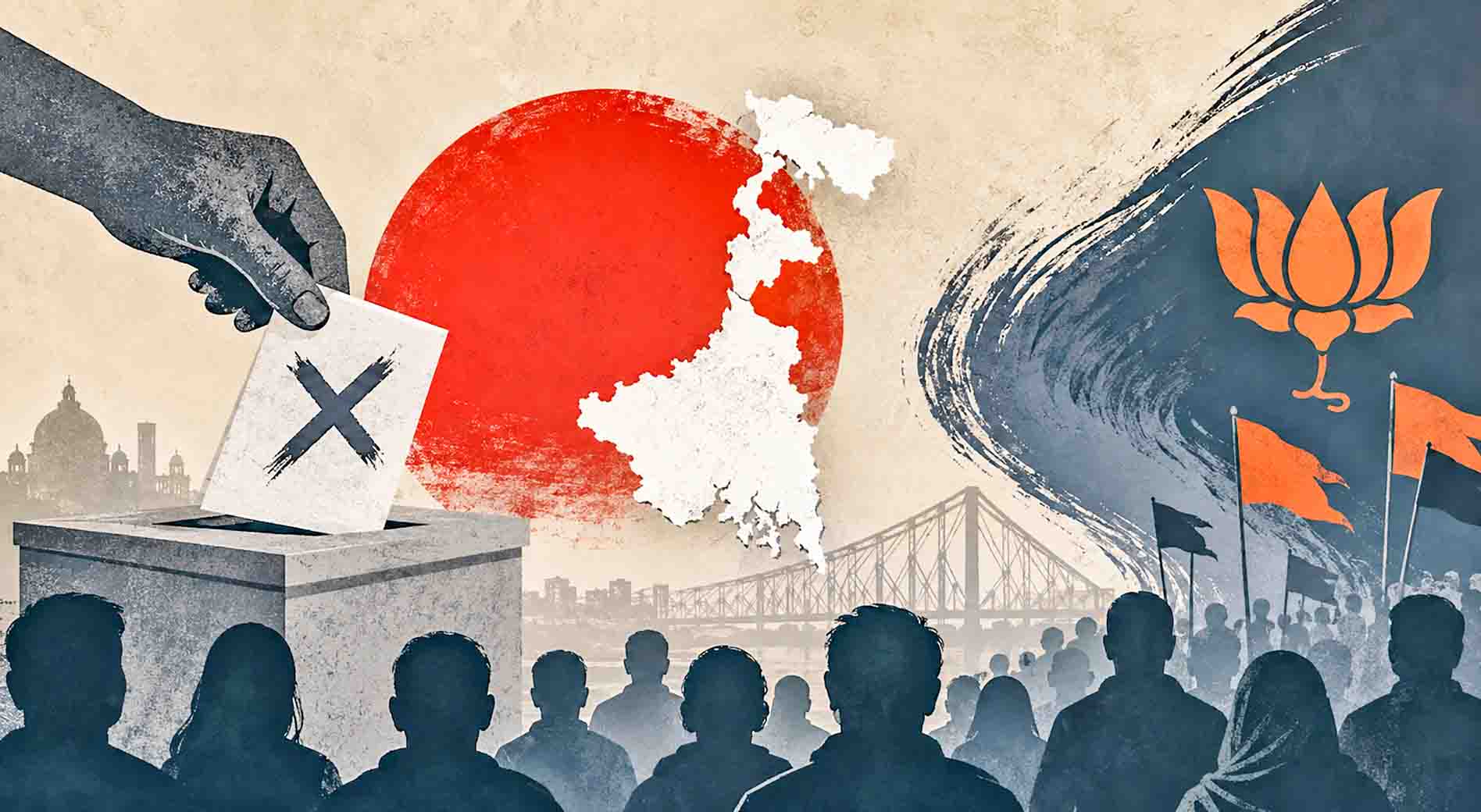
If the defeat of the ruling Trinamool Congress in the West Bengal Assembly election is explained solely through electoral arithmetic, vote swings, or administrative tactics—such as the Special Intensive Revision (SIR) of the electoral rolls and the role of the Election Commission—it would obscure the underlying political reality. A deeper analysis reveals that the outcome is fundamentally the result of a class realignment, in which contradictions within the ruling class have assumed a new form, while the far-right Hindutva force, the Bharatiya Janata Party (BJP), has successfully capitalized on the discontent of the oppressed classes. Marxism teaches us that the state is never neutral; it is always an instrument for maintaining the dominance of the ruling class. Viewed from this perspective, the Trinamool Congress's defeat in this election was not an unexpected event but rather the natural consequence of its class character.
For a long time, the Trinamool Congress projected itself as a party of the poor. In reality, however, it functioned as a kind of intermediary force that sustained its rule within the capitalist system through a number of welfare programs. While this model proved effective in its early years, its limitations gradually became apparent. Public resentment accumulated over issues such as land rights in rural areas, employment in urban centers, and corruption in the education sector. In the absence of a genuine left-wing alternative, that anger gravitated toward the far-right, fascistic forces. The central question, then, is why this discontent did not find its way to the Left. The answer is that the Left itself drifted away from the politics of class struggle and became accustomed to the comfort of parliamentary politics.
Class struggle is not merely a theoretical concept; it is a strategy for real political struggle. Yet contemporary left-wing politics has become disconnected from that struggle, detached from the labor movement, and detached from the peasant movement. Into this vacuum, religious polarization has easily entered. The BJP took advantage of this opportunity. It did not create anything fundamentally new; it simply succeeded in channeling existing social discontent to its own advantage. In other words, it replaced class struggle with a "conflict of religious identities." Along with other right-wing parties, the Trinamool Congress sought to address the issue through a form of soft Hindutva. The parliamentary Left turned a blind eye to the matter and failed to develop a political alternative capable of confronting Hindutva forces.
The public resentment directed at the Trinamool Congress was genuine. Political intimidation, administrative extortion, and corruption had generated widespread anger. However, the Left failed to organize that anger and provide it with a revolutionary direction. Instead, the parliamentary Left often presented its opposition to the Trinamool Congress in ways that indirectly benefited the BJP. This political error was not merely strategic; it reflected ideological bankruptcy. When there is confusion over identifying the principal enemy, politics is inevitably led down the wrong path.
One particularly striking development has been the response of the parliamentary Left, especially the CPI(M), in the aftermath of the election. Rather than exposing what it describes as state-sponsored vote rigging and fascism, it has continued to focus its attacks solely on the Trinamool Congress. By its conduct, it too has become a significant partner in this fascist victory. A large section of its support base consists of upper- and middle-class Hindu bhadralok, many of whom have celebrated the BJP's victory in a manner that echoes the party itself. They also promoted the same narrative as the BJP, arguing that a proper Special Intensive Revision (SIR) of the electoral rolls was necessary because Trinamool leader Mamata Banerjee wins elections with the votes of ghuspetiyas (infiltrators), among other claims. The extent of the anti-Muslim prejudice within these circles became starkly evident in the BJP's capture of West Bengal in this election. Their leadership played the role of a skilled strategist in weakening Muslim unity, thereby assisting the BJP while simultaneously directing their own Hindu votes toward the party.
The 7 percent vote swing from the Trinamool Congress to the BJP in this election cannot be attributed to a single factor. It was the outcome of a collective process in which economic hardship, social uncertainty, insecurity, and political disillusionment all converged. The rural poor, who had previously depended on the Trinamool Congress, began searching for an alternative. The urban lower middle class, frustrated by the loss of employment and educational opportunities, also became increasingly discontented. The grievances of these two social groups came together, but they ultimately found political expression through far-right fascism. This happened because the Left failed to demonstrate the organizational strength needed to channel that anger.
Religious polarization undoubtedly played an important role, but it would be a mistake to regard it as the primary cause. It served as a veil behind which the real economic issues were obscured. When an unemployed young person cannot find work and is told that the source of his hardship is people of another religion, frustration can easily lead him into that narrative. In such a helpless situation, he surrenders himself to an invisible force because no alternative explanation is presented to him. It was the responsibility of the Left to provide that alternative—to show that his enemy was not someone of another faith, but rather the economic system that had left him unemployed. That responsibility was not fulfilled.
If the Left genuinely wants to fight fascism, it cannot rely solely on moral authority or theoretical superiority. It must also build an effective political force. The question now is: What should the Left do? It no longer has the option of taking a middle path. It must either return to the politics of class struggle or resign itself to the margins of history.
What is needed now is a resolute, fearless, and uncompromising left-wing politics in which class struggle becomes not merely a slogan but a concrete political program. It must be rooted in the everyday struggles of ordinary people and take tangible form in the streets, factories, and fields. Through collective struggle, people must be helped to understand the root causes of their problems. Otherwise, this defeat will not remain confined to the Trinamool Congress; it will become a defeat for the entire progressive left. And that defeat, in turn, will devastate the lives of the ordinary people of West Bengal.
Now that Hindutva fascist forces have taken control of West Bengal, the foremost task in this difficult moment is to recognize fascism as the principal danger and to unite all democratic forces in resistance against it.