

When we speak of multidimensional diplomacy and the "Look East Policy"—whose primary objective is to strengthen economic, political, and strategic relations with the countries of East and Southeast Asia—Bangladesh's absence from the world's two major economic blocs, ASEAN and BRICS, underscores a significant strategic gap.
The current global order is no longer shaped by the dominance of a single superpower. Alongside Washington and Brussels, power centers such as Beijing, New Delhi, Jakarta, and Pretoria have emerged as equally important players in the global economy and international politics. In this multipolar world, the two most attractive economic groupings for developing countries are the Association of Southeast Asian Nations (ASEAN) and BRICS, the global bloc of emerging economies. Although Bangladesh is geographically and strategically situated between these two powerful groupings, it has yet to become a full member of either. Yet, as Bangladesh stands on the threshold of graduating from the category of Least Developed Countries (LDCs), engagement with these two blocs is no longer a matter of choice or luxury; it has become one of the essential prerequisites for safeguarding the country's economic future.
Historically, Bangladesh is a founding member of the South Asian Association for Regional Cooperation (SAARC). However, the organization has effectively become dormant because of the longstanding political rivalry between India and Pakistan and has failed to play an effective role in promoting regional economic cooperation. By contrast, ASEAN's stringent membership criteria, together with the complexities arising from the Rohingya crisis involving Myanmar, have long impeded Bangladesh's accession. Similarly, during the expansion of BRICS at the Johannesburg Summit in 2023, Bangladesh did not secure full membership because of geopolitical realities and the lack of consensus among member states. It did, however, become a partner of the New Development Bank (NDB). As a result, Bangladesh's continued exclusion from these two important groupings has created a strategic constraint that must be overcome without delay.
The primary reason for this urgency lies in Bangladesh's evolving economic realities. Following its graduation from LDC status, the country will lose duty-free export access to a number of developed markets, including those in Europe. In this context, access to the ASEAN market of more than 700 million people could open up a new horizon for Bangladesh's export sector. At the same time, becoming part of ASEAN's regional value chains would enable Bangladesh to further expand production and investment cooperation with countries such as Vietnam, Thailand, and Malaysia.
On the other hand, BRICS is not merely an economic bloc; it has become a new symbol of the evolving balance in the global economy. By engaging with BRICS, Bangladesh would have the opportunity to reduce its excessive dependence on the U.S. dollar by expanding trade in local currencies. At the same time, it would gain greater access to infrastructure financing from the BRICS New Development Bank (NDB) on comparatively favorable terms. In other words, while ASEAN can provide Bangladesh with access to new markets and stronger regional connectivity, BRICS can offer an alternative economic framework and greater strategic balance.
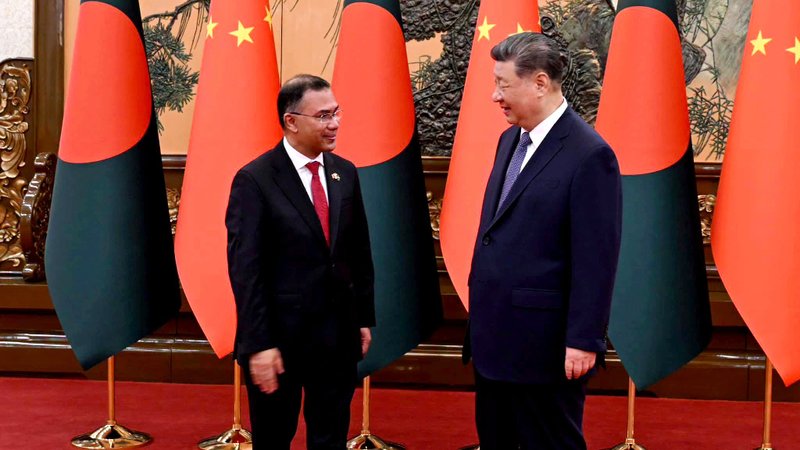
Recognizing this reality, Bangladesh has in recent years injected new momentum into its eastward-oriented diplomacy. During the Prime Minister's recent visits to China and Malaysia, Bangladesh's engagement with ASEAN and BRICS received particular emphasis. Malaysia expressed its support for Bangladesh's aspiration to become an ASEAN Sectoral Dialogue Partner. China, meanwhile, reaffirmed its commitment to supporting Bangladesh's inclusion in BRICS. The discussions also covered the Belt and Road Initiative (BRI), infrastructure development, and regional economic connectivity in a positive spirit. These initiatives demonstrate that Bangladesh is placing greater importance on multidimensional diplomacy and seeks to build balanced international partnerships rather than relying on any single power.
Nevertheless, the limitations of these two blocs cannot be overlooked. ASEAN's greatest strength lies in its ability to maintain long-term stability and economic cooperation among its member states despite their political and ideological diversity. However, because of its principle of non-interference in the internal affairs of member states, the bloc has been unable to play an effective role in addressing humanitarian crises such as the Rohingya crisis in Myanmar.
Similarly, one of BRICS' major achievements has been the creation of an alternative economic platform outside the sphere of Western economic dominance. Yet geopolitical differences among its members—including the border dispute between India and China—have, in many respects, limited the bloc's effectiveness. As a result, important initiatives such as establishing a common currency or implementing coordinated economic policies have yet to achieve the expected level of progress.
Even so, in today's global landscape, ASEAN and BRICS remain two of the principal driving forces of the world economy. At a time when SAARC has become largely inactive, Bangladesh has little practical alternative but to strengthen its engagement with other regional and global economic platforms. The government's recent diplomatic initiatives are certainly encouraging. However, they should not remain confined to official visits and joint declarations. Through domestic economic reforms, skilled diplomacy, and effective international lobbying, Bangladesh must deepen its relationship with both ASEAN and BRICS. Otherwise, if it fails to integrate itself into this eastward economic momentum in a timely manner, the country risks falling significantly behind in the global competition of the future.
Topics:
BangladeshChinaASEANBRICSAssociation of Southeast Asian NationsLeast Developed CountriesSouth Asian Association for Regional CooperationSAARCOpinion