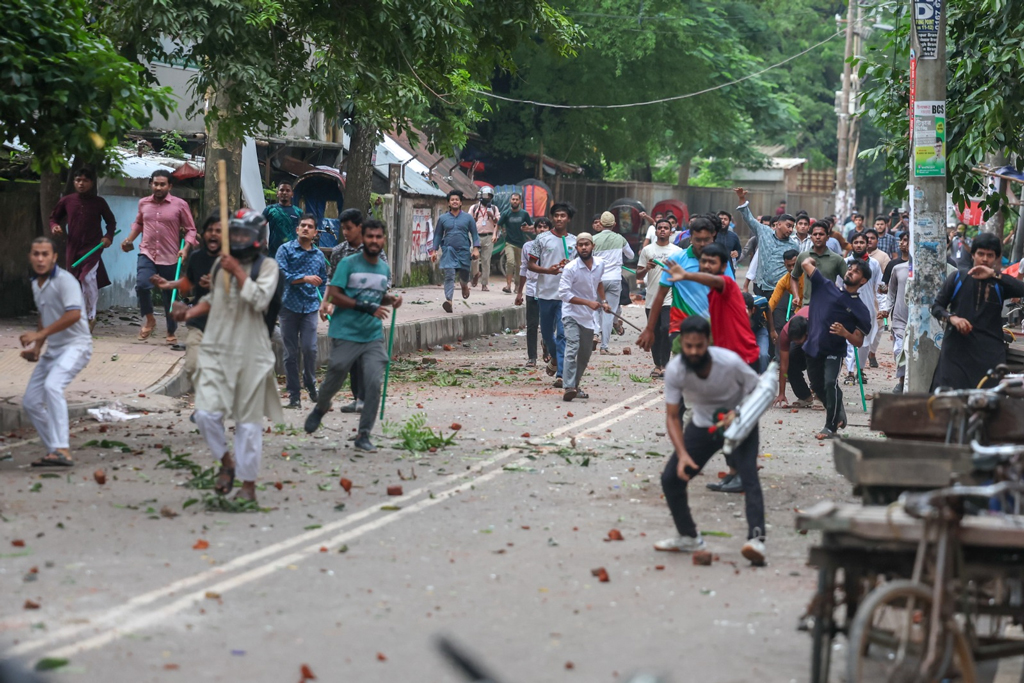
Nearly two years after the July 2024 quota reform movement called for an end to party-affiliated student politics, student organisations in Bangladesh say the demand remains unmet, and blame continued campus unrest on the same political patronage system. More than 50 people were injured in clashes involving activists of Jatiyatabadi Chhatra Dal, Islami Chhatra Shibir and Jatiya Chhatra Shakti at at least seven educational institutions from Monday night to Wednesday.
The clashes were reported at Begum Rokeya University in Rangpur, Jagannath University in the capital, Dhaka College, Government Shaheed Suhrawardy College, Government Alia Madrasa, the University of Barishal and Government Tolaram College in Narayanganj. Fights among activists of the three student organisations were also reported in several districts on Wednesday, creating instability at educational institutions.
Student organisations are trading accusations over why the seventh of the Anti-Discrimination Student Movement’s nine demands has not been fulfilled. That demand called for banning “party-affiliated student politics” and activating student unions at all educational institutions, including Dhaka University, Jahangirnagar University, the University of Chittagong and Rajshahi University.
The nine-point charter was announced on 19 July 2024 by Abdul Kader, then one of the coordinators of the Anti-Discrimination Student Movement, during the quota reform protests. One of the movement’s declared demands during July 2024 was to stop “party-affiliated student politics”. In the aftermath of that movement, the then Awami League government was ousted on 5 August that year in the face of a mass uprising.
Two years on, student leaders say Bangladesh Chhatra League has been banned as a terrorist organisation and student union elections have been held at several universities, but student politics has not been freed from party affiliation.
Abdul Kader, who presented the demand to ban party-affiliated student politics, told Ajker Patrika that the aim of the seventh demand was not only to prohibit such politics, but also to create a political settlement over the future structure of student politics in educational institutions. “That goal has not been achieved,” he said.
Nasir Uddin Nasir, central general secretary of Jatiyatabadi Chhatra Dal, said his organisation had disagreed with the demand at the time. “Chhatra Shibir had deceptively put forward the demand to stop student politics in order to continue its covert politics for political purposes. We rejected this demand at the time. Yet later it was seen that they themselves were doing party-affiliated politics. They campaigned for Jamaat-e-Islami leaders. They are implementing the party’s agenda,” he said.
Nurul Islam Saddam, central president of Islami Chhatra Shibir, said the nine-point charter had been drafted by Chhatra Shibir and that the organisation had repeatedly clarified what it meant by ending party-affiliated student politics in the seventh point. He said that at the time, no political student organisation except Chhatra League, now banned, had been able to operate at universities, and students were forcibly taken to Awami League programmes and tortured if they refused. “It was in that context that the demand to stop party-affiliated politics was made,” he said.
On allegations that Chhatra Shibir leaders took part in election campaigning for Jamaat candidates, Nurul Islam Saddam said voting was a democratic right and that anyone could vote or campaign for someone. He said that did not amount to organisational subservience and added that the term “party-affiliated student politics” needed to be defined.
Commenting on the current tension and violence, the Chhatra Shibir president said the main causes of the clashes were attempts to establish dominance on campuses and blind politicisation of administration along party lines.
Questions have also been raised over whether student organisations are more active in pursuing party interests than in advocating for ordinary students’ demands.
Tamjid Haidar, central president of a faction of the Bangladesh Students Union, said those who had once demanded an end to party-affiliated student politics were now engaging in the same practice. He said the activities of Jatiya Chhatra Shakti, the student organisation linked to the National Citizen Party, reflected that trend. According to him, the group was not speaking out on students’ demands, campus crises or student rights, but appeared more active in the National Citizen Party’s political programmes. “As a student organisation, they are giving more importance to party programmes than to independent programmes. That is the characteristic of subservient politics,” he said.
Jahid Ahsan, president of Jatiya Chhatra Shakti, said: “We are an ideologically allied organisation of the National Citizen Party. But we are independent in decision-making. We do not operate in the conventional sense as an affiliate of any political party. We have our own organisational decisions and programmes. However, on various issues, including the July National Charter, we may stand alongside any party or organisation. That can be not only with the NCP, but also with the BNP.”
Relevant observers say campuses have once again become volatile because of the continued practice of party-affiliated student politics. Of the three organisations now involved in tensions and clashes, Chhatra Dal is the student wing of the ruling BNP, Chhatra Shibir is the student wing of Jamaat-e-Islami, the opposition party in parliament, and Jatiya Chhatra Shakti is the student organisation of the National Citizen Party, formed by young leaders who led the Anti-Discrimination Student Movement. The party’s convener, Nahid Islam, is the opposition chief whip in parliament and was one of the key coordinators of that movement.
Badiul Alam Majumdar, a member of the National Consensus Commission during the previous interim government and editor of Shujan, said it was deeply unfortunate and unacceptable that some of the young people who once demanded an end to party-affiliated student politics were now involved in the same kind of politics. “Unless the culture of party-affiliated student politics, teacher politics, and affiliate and associate organisations of political parties is abolished, the anarchy we see on our campuses will not stop,” he said.