The Prime Minister's Visit to China Was No Routine Diplomatic Trip
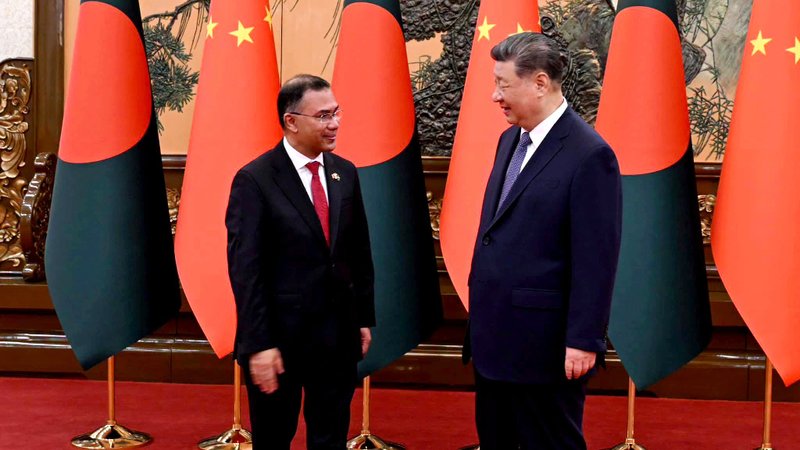
Following the assumption of office, Bangladesh's Prime Minister, Tarique Rahman, made his first official overseas visits to Malaysia and China. Heads of government and state routinely travel abroad for diplomatic and economic purposes. However, Prime Minister Tarique Rahman's visits cannot be viewed merely as routine engagements. They took place against the backdrop of an ongoing realignment in global politics, particularly the emergence of a new phase of geopolitical competition in South and Southeast Asia.
There are also practical reasons why Prime Minister Tarique Rahman chose to accord such importance to China at the very beginning of his tenure. Bangladesh's economy, once regarded as one of South Asia's success stories, has now lost momentum. In this context, Chinese investment and capital could become increasingly important for Bangladesh over the long term. More broadly, Bangladesh has relatively few deep and multidimensional strategic partners. From that perspective, China stands out as an exceptional and effective global partner. Moreover, public sentiment in Bangladesh is noticeably more favorable toward China than toward India. Against this backdrop, Tarique Rahman's visit to China carries a positive political message for the new government. By contrast, a visit to India at this time could have posed significant political risks for the administration.
Perhaps for that reason, the Prime Minister's visit generated considerable public interest. Following its conclusion, the discussion has centered on what Bangladesh gained from it. Some observers have described the visit as only a limited success because it did not produce announcements of large-scale loans, grants, or immediate investments. Others argue that the visit's most significant achievement was not tangible economic gains but rather the renewal of mutual confidence and the establishment of a foundation for broader future cooperation. The reality probably lies somewhere between these two assessments.
After the Prime Minister returned home, the government held a press conference to brief the public on the visit. Prime Minister Tarique Rahman also elaborated on the trip in a speech delivered in the National Parliament. It is evident from these statements that one of the key elements of the joint declaration was China's commitment to support Bangladesh's Teesta Mega Project. The Prime Minister emphasized that the Teesta Mega Project would indeed be implemented. Meanwhile, Beijing has once again proposed the establishment of an economic corridor connecting Bangladesh to China through Myanmar in order to expand connectivity and economic cooperation between the two countries. Bangladesh is now considering that proposal as well.
Major economic partnerships or strategic cooperation between two countries are never established through a single meeting, particularly when at least one of the governments is newly formed. They first require stable political engagement, mutual trust, assurances regarding each country's national interests, and a shared understanding of long-term objectives. From that perspective, this visit signals the strong possibility that Bangladesh-China relations are entering a new phase. However, opening the door to opportunity is not the same as capitalizing on it. The real test begins now.
Given Bangladesh's current realities, foreign investment is one of the key prerequisites for economic recovery. Compared with many competing countries, Bangladesh lags behind for a variety of reasons. Large-scale investment is needed to improve infrastructure, including the energy sector, facilitate technology transfer, and enhance export capacity. In this regard, China—with its vast foreign exchange reserves—can undoubtedly become an important partner. Over the past decade, several major Chinese-funded projects, including the Karnaphuli Tunnel, the Dhaka-Ashulia Elevated Expressway, the Dasherkandi Sewage Treatment Plant, the development of Payra Port, and industrial zones, have already brought visible improvements to Bangladesh's development infrastructure. The deeper Beijing's political relationship with the new government becomes, the greater the opportunities for economic cooperation.
Investment, however, never depends solely on diplomatic relations. Investors are guided by capital, and their decisions are based on meticulous calculations of profit, loss, and risk. They place great importance on political stability, law and order, policy consistency, and administrative efficiency. Traditionally, many of Bangladesh's opportunities have failed to materialize because of political instability, policy uncertainty, bureaucratic delays, and corruption. Therefore, no matter how warm Bangladesh's relations with China become, the expected benefits will be difficult to achieve unless the country can ensure an investment-friendly domestic environment.
The discussions during the Prime Minister's visit regarding economic zones, Mongla Port, industrial cooperation, and investment are certainly encouraging. Much of this, however, still remains at the level of potential. Memorandums of Understanding are highly significant because they lay the groundwork for future cooperation. Yet it would be a mistake to treat them as final achievements. Bangladesh's experience shows that many MoUs signed in the past have remained confined to paper and never progressed beyond that stage. What is needed now is a time-bound implementation plan, a mechanism to monitor progress, and an effective framework to translate these understandings into reality.
One of the most widely discussed aspects of the visit was the proposal for a Bangladesh-China-Myanmar Economic Corridor. The proposal came from China. Several years ago, there had been discussions about the Bangladesh-China-India-Myanmar (BCIM) Economic Corridor, but the initiative did not materialize because of India's objections. Under the new geopolitical realities, if discussions on the trilateral Bangladesh-China-Myanmar corridor move toward implementation, Bangladesh will have the opportunity to transform its geographic location into an economic asset. The country's strategic position along the Bay of Bengal has long attracted the attention of major international powers. If this advantageous location can be leveraged for economic gain, it will undoubtedly benefit Bangladesh.
At the same time, there are ample reasons for caution. The strategic rivalry among China, India, and the United States in South Asia and the Indo-Pacific is now an undeniable reality. Bangladesh's success will depend on its ability to maintain balanced relations with all sides without aligning itself too closely with any one of them. For a country like Bangladesh, which is on the path toward becoming a middle-income economy, such multidirectional diplomacy is a practical necessity. Excessive dependence on any single power would be risky, while unnecessary confrontation would likewise be contrary to the country's national interest.
It is also evident that warmer relations with China could strengthen Bangladesh's bargaining position with other countries. Bangladesh's negotiating leverage with the United States, the European Union, and another regional power, India, will be stronger when it has multiple effective international partners.
The visit has also raised fresh hopes regarding the Rohingya crisis. China wields considerable influence over Myanmar and has substantial economic interests there. Given this reality, it is difficult to regard China as a completely neutral mediator. Nevertheless, Beijing's positive attitude toward Bangladesh can be utilized to advance engagement with Myanmar on the issue of Rohingya repatriation. Resolving this crisis, which has persisted for nearly a decade, requires robust diplomatic initiatives.
The discussions on integrated management of the Teesta River, water resource development, flood forecasting, river dredging, and cooperation in the blue economy—a sustainable economy based on marine resources—are also significant. At a time when Bangladesh faces growing risks from the impacts of climate change, technology- and knowledge-based cooperation has become particularly important. To realize the potential of the blue economy, a coordinated approach combining research, technology, and investment is essential. In this regard, Bangladesh will be eager to welcome China's assistance.
Another important task before Bangladesh is to reduce its large trade deficit with China. Economic relations cannot be balanced through infrastructure projects or loans alone. Bangladesh must also work to expand market access for its products in China and secure tariff concessions.
Finally, it must be said that the cornerstone of Bangladesh's foreign policy should be its national interest. Relations with any country should be based not on emotion but on mutual interests and mutual respect. While China is an important partner for Bangladesh, so too are the United States, the European Union, and Japan—major development partners—as well as India, its closest neighbor with which it shares longstanding historical ties. The ASEAN region and the Middle East are likewise of great importance to Bangladesh.
Last Thursday, Chinese Ambassador Yao Wen addressed a press conference at the Chinese Embassy in Dhaka regarding the Prime Minister's visit. He said that Bangladesh-China relations are advancing on the basis of mutual respect, sovereignty, and the principle of non-interference in each other's internal affairs. Therefore, the Prime Minister's visit should not be seen as the final word but rather as the beginning of a new phase of progress. Its true significance may only become clear several years from now, when it can be assessed how many of the understandings have been translated into concrete projects, how much investment has materialized, and how many jobs have been created. Until then, the results will have to be awaited.
Writer: Acting Editor, Ajker Patrika