

The University of Queensland: Courses, Costs, Scholarships and Future Opportunities
A high global ranking can put a university on a student’s shortlist. It should not, by itself, decide where that student spends the next few years.
For international students, the more useful questions come afterwards. Does the university offer the right program? How strong is its research in the area you want to pursue? What will the degree actually cost? Is meaningful financial support available? And what kind of academic, social and career environment will you enter once you arrive?
These are useful questions to ask about any university. They are particularly relevant when considering The University of Queensland, or UQ, one of Australia’s best-known research universities.
Based in Brisbane, UQ combines more than a century of history with a large international community, extensive research activity and a wide range of undergraduate and postgraduate study options. In the QS World University Rankings 2027, UQ is ranked equal 40 th globally; the Times Higher Education World University Rankings 2027 places it equal 73 rd.
Those rankings may attract attention. But they are only the beginning of the story.
From 83 students to an international university
UQ was formally established in 1910 after legislation passed by the Queensland Parliament in 1909. Teaching began in 1911 at Brisbane’s Old Government House with only 83 students across Arts, Science and Engineering.
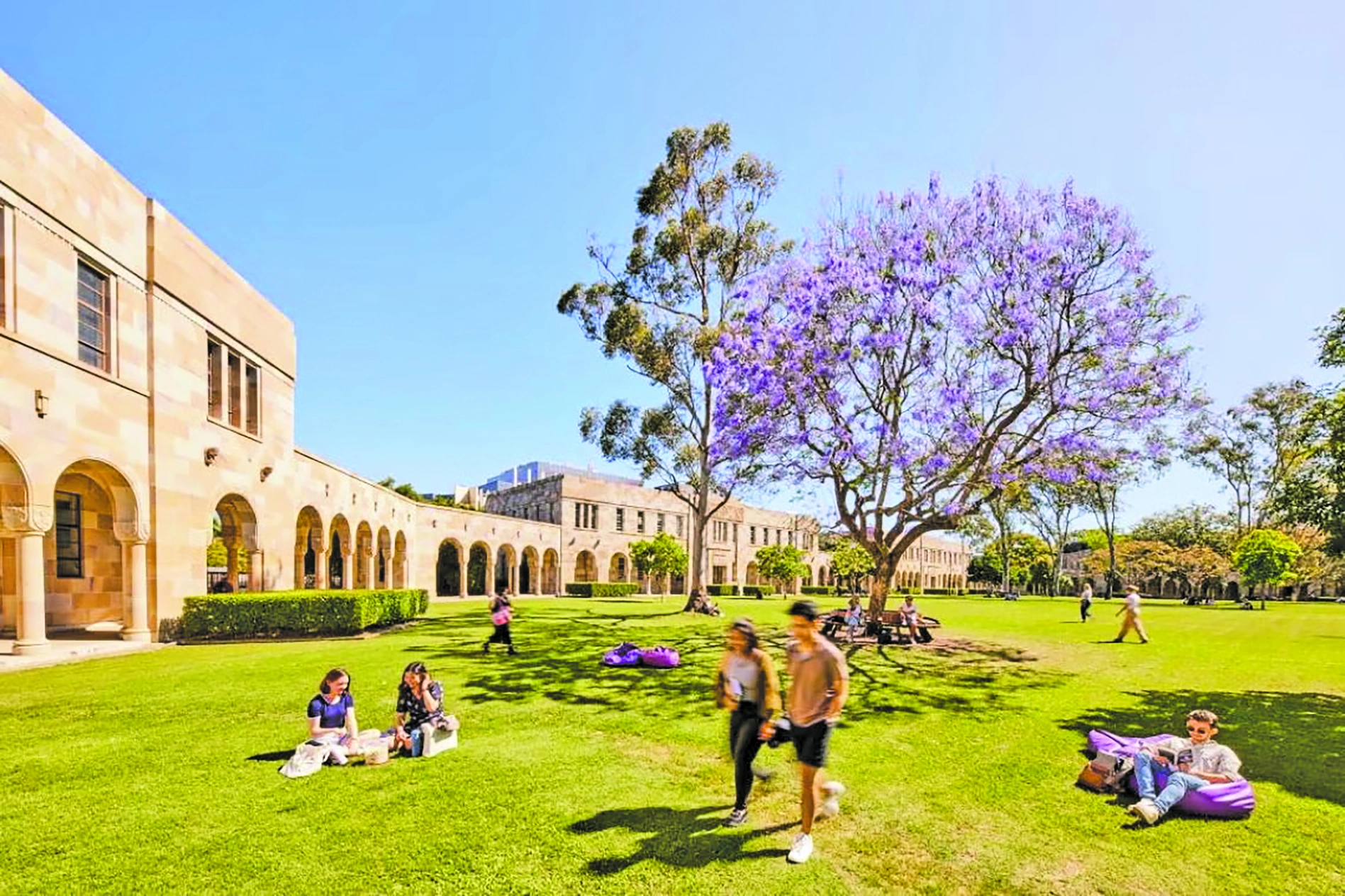
Its main campus today is at St Lucia, about seven kilometres from central Brisbane. Spread across 114 hectares beside the Brisbane River, it brings together the heritage-listed sandstone Great Court, jacaranda-lined spaces, libraries and museums with modern laboratories, research facilities and sporting infrastructure.
The setting is attractive, but for a prospective student the more important question is what happens academically inside it.
What can you study?
UQ offers programs across areas such as science, engineering, business and economics, education, law, health and medicine, agriculture, environment, humanities and the social sciences. Students can enter through undergraduate study, honours, postgraduate coursework or higher degrees by research.
That breadth gives applicants considerable choice. It also makes careful program selection important.
Two universities may offer degrees with similar names but very different course structures, specialisations, research strengths and professional pathways. A student interested in education, for example, should look beyond the university’s overall ranking and examine the actual fields available, the courses taught and how the program connects with their professional plans.
Cost also deserves attention early.
For an international student, UQ lists an indicative annual tuition fee of A$ 56,800 for the Bachelor of Science in 2027. The 2027 international fee for the Master of Educational Studies is A$ 48,080. These are examples rather than a university-wide price: fees vary substantially by program and may change from year to year.
For a Bangladeshi family, those figures are substantial even before accommodation, food, health insurance, transport, travel and other living costs are added. An academically attractive degree therefore still needs to make financial sense.
For research students, fit matters more than the university name
Research is one of UQ’s major strengths, with substantial activity across health, biomedical science, engineering, agriculture, environment, science and the social sciences.
But a PhD applicant should not choose a university simply because it is highly ranked.
The quality of the match between the proposed research and the expertise available in the school, institute or research group can be far more important to the day-to-day doctoral experience. A prospective researcher needs to ask: Who is working in my area? Is there an appropriate supervisor or project? Does the research environment support the kind of work I want to do?
That search should begin before an application is submitted.
Funding can also change what is financially possible. UQ’s Graduate Research School scholarships include the Australian Government Research Training Program. At the 2026 rate, the living stipend is A$ 39,220 per year, tax-free and indexed annually. The scholarship information also lists tuition support and single Overseas Student Health Cover for eligible international recipients.
These awards are competitive, so research applicants should not treat funding as automatic simply because they meet the admission requirements.
An international campus, not just international marketing
International students form a substantial part of UQ’s community. UQ’s 2025 statistics show a student population of around 60,000, with international students accounting for 39.7 per cent.
That matters in everyday university life. A student at St Lucia is likely to study alongside classmates from many countries and encounter a wide range of languages, cultures and academic experiences.
For students arriving from Bangladesh, a large international community may make the transition less isolating. Student clubs and associations can also provide social and cultural connections outside formal study.
But an international campus does not remove all the challenges of studying abroad. Students still have to adjust to a different academic culture, manage independent living, communicate across cultures and handle the financial and emotional demands that can come with being far from home.
That side of overseas education deserves as much consideration as campus photographs and ranking tables.
What scholarships are available?
For coursework students commencing in 2027, UQ currently lists several scholarships for international applicants.
The UQ International Excellence Scholarship offers eligible high-achieving international students a 25 per cent reduction in tuition fees for the duration of an undergraduate or postgraduate coursework program. UQ also lists an International High Achievers Scholarship offering a 20 per cent tuition fee reduction for eligible students commencing in 2027.
For students comparing universities, it is important to read the details rather than simply noting that “scholarships are available”. A partial tuition reduction is very different from full funding, and neither should be confused with a living stipend.
Applicants should calculate what remains to be paid after any scholarship, and whether that amount is realistic for them and their family.
Admission: check the program, not a Facebook post
Entry requirements differ across degrees.
For most UQ programs, the general minimum English language requirement is an IELTS overall score of 6.5 with at least 6.0 in each component, or an accepted equivalent. Some degrees require higher English scores or additional conditions.
Academic requirements also depend on the level and program. Undergraduate applicants, coursework master’s applicants and prospective PhD researchers are assessed differently.
This is where students need to be careful with advice from social media groups, education agents or even friends who applied previously. Their experience may be useful, but entry requirements and procedures can change.
The safest starting point is always the current page for the exact program you intend to apply for.
What happens beyond the classroom?
A university degree is not only about passing courses.
UQ’s employability activities include internships, work-integrated learning, undergraduate research, career events, volunteering and other opportunities intended to help students connect university learning with professional development. UQ reports more than 3,200 internships, jobs and placement opportunities advertised to students through its employability activities.
These opportunities can matter, but students also need realistic expectations.
A degree from a highly ranked Australian university does not guarantee a job. It does not guarantee permanent residence in Australia either.
Career outcomes depend on many factors: the field of study, demand for particular skills, work experience, professional networks, communication abilities, individual performance and the wider labour market. Immigration and post-study work rules can also change, so students should check current Australian Government requirements rather than building a long-term plan around old visa information.
So, is UQ the right choice?
For some students, UQ may be an excellent fit.
It offers a long-established academic environment, strong research infrastructure, a large international community, a distinctive riverside campus and a range of scholarship and employability opportunities. Its global rankings provide one indication of academic standing.
But choosing a university should ultimately be more personal and more practical than choosing a number on a ranking table.
Can you find the program you actually need? Is there the right research expertise? Can you finance the degree responsibly? Does the academic environment fit your goals? And can you see how the experience may contribute to what you want to do afterwards?
For an international student, those questions matter more than whether one university sits a few places above another in a global league table.
UQ may get onto your shortlist because of its ranking.
Whether it should remain there depends on everything beyond it.
Md Rabiul Alam
PhD Researcher and Casual Academic
The University of Queensland, Australia