
Ayatollah Ali Khamenei's Coffin Displayed as Iran Begins Week-Long State Funeral
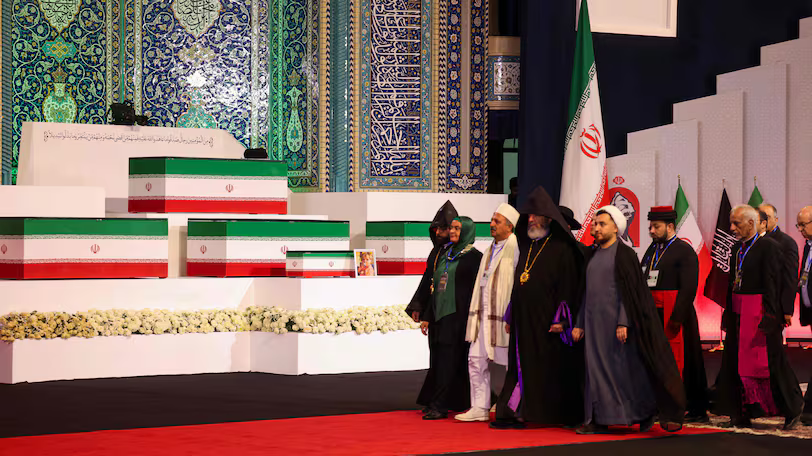
Iran has begun a week-long series of funeral ceremonies for Supreme Leader Ayatollah Ali Khamenei, whose coffin was placed on public display at Tehran's Grand Mosalla on Friday, marking the start of what authorities expect to be one of the largest state mourning events in the country's history.
Khamenei, who was killed during the opening phase of the US and Israel's military campaign against Iran in late February, is being honoured with ceremonies scheduled across Iran and Iraq before his final burial in the north-eastern city of Mashhad.
His coffin was displayed alongside those of several family members, including his granddaughter, as senior Iranian officials gathered under heavy security. President Masoud Pezeshkian, Parliament Speaker Mohammad Bagher Ghalibaf and other members of Iran's political and military leadership attended the opening ceremony. However, it remained uncertain whether Iran's new Supreme Leader, Ayatollah Mojtaba Khamenei, the late leader's son and successor, would make a public appearance.
Foreign dignitaries also began arriving in Tehran to pay their respects. Delegations from Russia, China, Pakistan, Iraq and India are expected to participate in different stages of the funeral. Pakistan's Army Chief General Asim Munir and Iraqi President Nizar Amedi were among the early arrivals, while Russia is sending former President Dmitry Medvedev.
According to Iranian state media, Khamenei's body will lie in state at the Grand Mosalla through Sunday before a massive funeral procession takes place in Tehran on Monday. The cortege will then travel to the holy city of Qom on Tuesday before continuing to Iraq, where official ceremonies are scheduled in Najaf and Karbala. The final funeral rites will conclude in Mashhad on July 9, where Khamenei is expected to be buried.
Iranian authorities have tightened security throughout the funeral period. Military officials warned that any attempt to target the country during the ceremonies would trigger a severe response. Major General Ali Abdollahi cautioned that any "miscalculation" by Iran's adversaries would be met with what he described as a "harsh and regretful" reaction.
Friday's ceremony was largely restricted to invited guests, including the families of military personnel and those killed during the recent conflict. State television showed mourners dressed in black praying, weeping and chanting religious slogans as the coffins arrived at the mosque.
Officials expect millions of people to attend the processions, particularly in Tehran, where authorities say preparations are in place to accommodate as many as 20 million mourners. Visitors from neighbouring countries, including Pakistan, Afghanistan, India and Bangladesh, are also expected to join the ceremonies, especially during the final rites in Mashhad.
The funeral is widely seen as a significant political moment for Iran's leadership. Analysts say the scale of public participation could serve as an important indicator of the government's domestic support following months of conflict, internal unrest and the transition of power to Ayatollah Mojtaba Khamenei. While officials anticipate an unprecedented turnout, observers note that many Iranians critical of the country's ruling establishment may choose not to participate, reflecting the deep political divisions that continue to shape the country.