

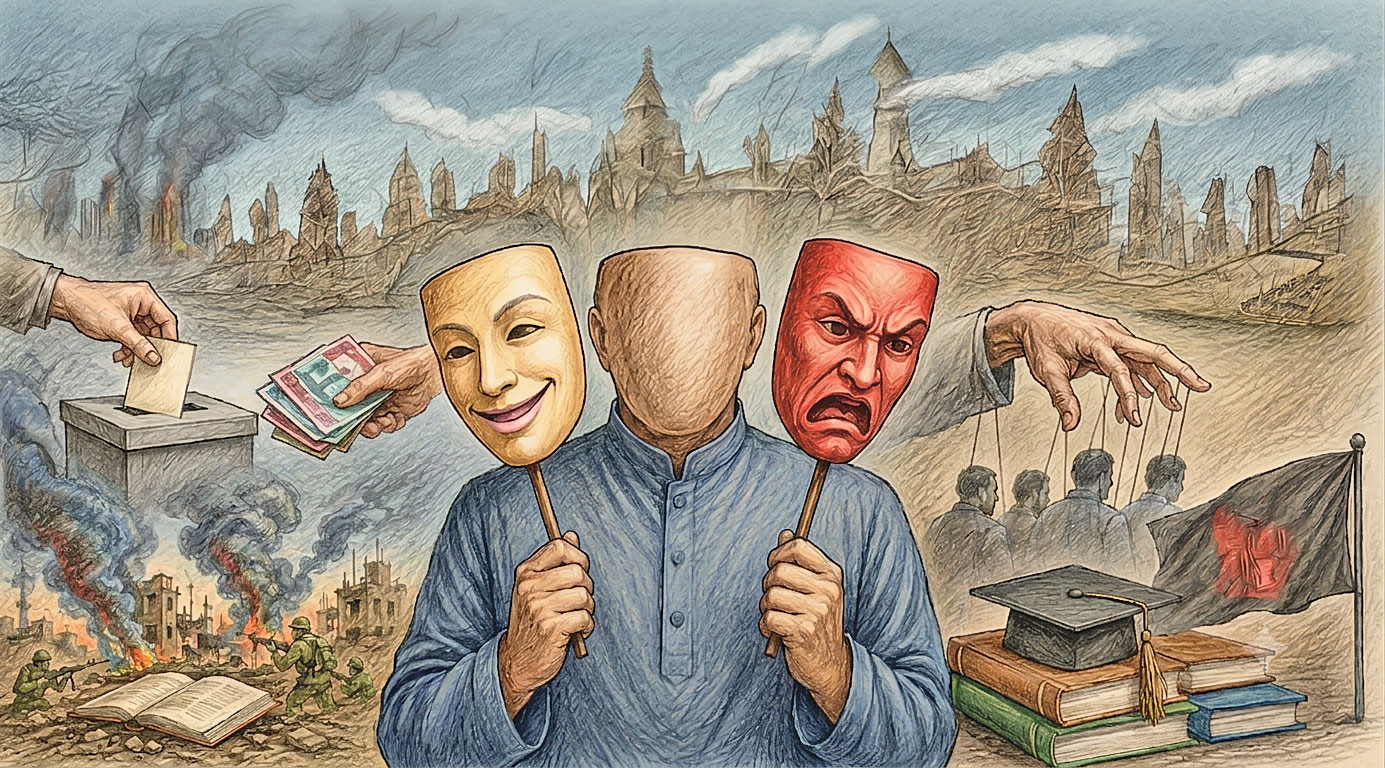
Perhaps the concept of double standards is easier to understand if described as hypocrisy. Although Jamaat initially opposed the creation of Pakistan, it later established its headquarters there and continued its anti-people activities. In Punjab, it instigated communal riots by demanding that the Qadianis be declared non-Muslims. One of its notable political campaigns was declaring jihad against efforts to enact the Muslim Family Laws Ordinance into law. The party considers women's ability to bear children as grounds for disqualifying them from leadership. Yet, during the Pakistan era, it supported Miss Fatema Jinnah as the Combined Opposition's candidate against Ayub Khan. In Bangladesh, it joined Sheikh Hasina in a united political movement. During Khaleda Zia's tenure as prime minister, it also showed no hesitation in allowing its Amir and Secretary General to serve as ministers under the leadership of a woman.
In the most recent National Election, Jamaat did not nominate a single female candidate, yet it had previously nominated women for the reserved seats in the same parliament and has done so again. Nor did it hesitate to send women door to door to solicit votes on behalf of the party. While committed to establishing Islamic rule, it saw no problem in nominating a member of the Hindu community as a candidate in the hope of winning an election. Some of its leaders are titled Amir, others Nayeb-e-Amir, and others Secretary General. Jamaat leaders take pride in their honesty and pledge to establish the rule of honest people in the country. Yet they do not hesitate to resort to falsehoods in pursuit of votes.
During the previous election, the party claimed that voting for Jamaat was equivalent to buying a ticket to heaven. Perhaps it hoped that impoverished people, standing on the edge of a burning hell, would be inspired by this promise and flock to vote for the party. Later, in the face of criticism, it claimed that the statement was a personal opinion rather than the party's official position. Images of money being openly distributed to buy votes have appeared on social media and subsequently been published in newspapers.
The late Ghulam Azam, Amir of Jamaat-e-Islami in East Bengal, left behind a striking example of double standards. He was an outright opponent of Bangladesh's Liberation War and supported the occupying Pakistani forces in their efforts to preserve Pakistan. Under the protection of those forces, Al-Badr, the student wing affiliated with Jamaat, brutally murdered many of the country's finest sons. After independence, Ghulam Azam left the country. It seemed he would never return to what he considered this impure land. But when circumstances became favorable, he returned, obtained citizenship, and enthusiastically resumed political activities.
After independence, The Daily Sangram, the mouthpiece of Jamaat-e-Islami, also began promoting the claim that Ghulam Azam had been a "Language Movement activist." It even presented evidence in support of that claim. The evidence was that, by circumstance, Ghulam Azam had been the nominated General Secretary of the Dhaka University Central Students' Union (DUCSU) in 1948. At that time, DUCSU elections were not held directly; offices were allocated to different residential halls on a rotational basis. In 1948, the position of Vice President went to Jagannath Hall, which nominated Arbinda Basu for the post. The position of General Secretary was allocated to Fazlul Huq Muslim Hall, which nominated Ghulam Azam. It should be noted that the Islami Chhatra Sangha had not yet been formed in East Bengal, and few people even knew that a party called Jamaat-e-Islami existed. As a young political science student, Ghulam Azam had no association whatsoever with Jamaat at the time.
Another relevant incident is that Prime Minister Liaquat Ali Khan visited Dhaka during that period, and DUCSU decided to present him with a memorandum demanding that Bangla be recognized as the state language. Naturally, the printed memorandum was to be read by Vice President Arbinda Basu. However, since he belonged to the Hindu community, there was concern that if the demand for Bangla as the state language were voiced by him, the Muslim League government might exploit the situation by portraying the movement as one inspired by Hindus. For that reason, Ghulam Azam was asked to read the memorandum instead. He had no role beyond that, nor could he have had one. It is solely on the basis of his reading that memorandum that the claim of Ghulam Azam being a Language Movement activist rests.
Yet in 1970, far from considering that episode a matter of pride, Ghulam Azam regarded it as a stain on his record. Evidence of this is found in a speech he delivered in West Pakistan, where he stated without reservation that Urdu alone should have been the state language and that the Language Movement had been a mistake. (Imtiar Shamim, Shanta Niropekkho Tattabadhayak Shontrash, 2025, p. 228).
One reason behind the dominance of Islami Chhatra Shibir in public universities is the expansion of madrasa education. Among the measures the Awami League government took to consolidate its hold on power was encouraging madrasa education. The number of madrasa students has been increasing steadily in any case. This is because the cost of such education is low and, in many cases, it is even available free of charge. As a result, children from poor families have the opportunity to become "educated." Consequently, while student enrollment in primary and secondary mainstream education has been declining, the number of madrasa students has continued to grow. Wealthy individuals establish madrasas, while showing very little interest in founding primary schools. There are three reasons for this. First, establishing a madrasa is easier and less expensive. Second, there is the belief that providing religious education brings both worldly respect and spiritual merit for the hereafter, making it profitable in both senses. Third, many among the wealthy believe that if the children of poor families enroll in madrasas, they will remain content within the cycle of poverty and will not compete with the children of the affluent.
It is also noteworthy that although the results of last year's Higher Secondary Certificate (HSC) examinations in the mainstream education system were the worst in the past five years, the results from the madrasa stream were not nearly as poor. This may have happened for two reasons. The first may be that madrasa teachers are more generous than mainstream examiners when evaluating answer scripts. The second is that madrasa education places greater emphasis on memorization. Students who memorize well can answer examination questions effectively and obtain high marks. In a sense, this is a form of cheating—not by bringing written answers into the examination hall, but by concealing them in one's mind. A third factor is that the coaching centers students attend before university admission tests do not provide education in the true sense; rather, they train students to answer examination questions. The memorization skills acquired by madrasa students are further strengthened through practicing answers to likely admission test questions, enabling them to outperform many other candidates.
Sheikh Hasina also put in place a system recognizing madrasa education as equivalent to general education. As a result, madrasa students combine strong performance in their madrasa-level examinations with success in university admission tests, allowing them to surpass candidates from the mainstream education system. For these reasons, students coming from the madrasa stream have come to dominate public universities.
Author: Emeritus Professor, University of Dhaka