
Bangladesh Presses India to Renew Ganges Water-Sharing Treaty
Bangladesh is urging India to begin negotiations on a new Ganges water-sharing agreement before the existing 30-year treaty expires on 12 December this year, warning that a failure to reach a deal could intensify dry-season water shortages and threaten agriculture, fisheries, the environment and the livelihoods of millions.
Rashed Al Mahmud Titumir, an adviser to Bangladesh Prime Minister Tarique Rahman and head of the technical committee on water sharing, said any new treaty must be based on “mutual benefit and respect”.
Dhaka has said India has yet to respond to Bangladesh’s request to renew the agreement.
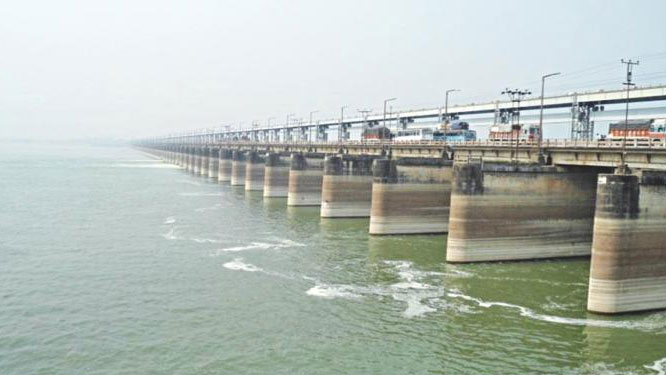
The 1996 Ganges water-sharing treaty governs dry-season water distribution between the two countries at India’s Farakka Barrage. India commissioned the 2.2-kilometre barrage in 1975, about 20 kilometres upstream from the Bangladesh border, and disputes over Ganges water distribution have continued since then.
Malik Fida A Khan, a former member of the Bangladesh-India Joint Rivers Commission, alleged that India had built excessive dams upstream on the Ganges. Malik Fida A Khan said a new agreement must consider climate-change impacts and give importance to water flows and demand across the entire river basin.
Long-running water dispute
India and Bangladesh have disputed the sharing of water from 54 common rivers for decades, with the Ganges among the most significant.
Bangladesh alleged after the Farakka Barrage began operating in 1975 that India was diverting most of the Ganges water elsewhere. A water-sharing agreement was reached in 1977 after United Nations intervention, but the arrangement lost effectiveness a decade later.
Sheikh Rokon of Dhaka-based environmental organisation Riverine People said the Ganges water-flow crisis had become severe during periods without an agreement.
“At least three rivers nearly dried up at the time,” Sheikh Rokon said.
The rivers included the Gorai, which supplies freshwater to the Sundarbans and plays an important role in limiting saline-water intrusion caused by rising sea levels.
Sheikh Rokon warned that the situation could be worse than in the past if the treaty is not renewed, as demand for freshwater has increased significantly in both India and Bangladesh.
Strained Dhaka-New Delhi relations
Negotiations on renewing the Ganges treaty are taking place amid strained relations between India and Bangladesh.
Former Bangladesh prime minister Sheikh Hasina fled to India after the 2024 mass uprising and remains there, in a country that had long been an ally. Sheikh Hasina, who was sentenced to death in absentia for crimes against humanity, has pledged to return from India to Bangladesh in December.
The Ganges water-sharing treaty signed by Sheikh Hasina is also due to expire in the same month.
Reports have said Prime Minister Tarique Rahman may visit India before the treaty expires, though no official announcement has been made.
India’s Ministry of External Affairs has said river-related discussions fall under the Joint Rivers Commission. The commission’s most recent technical meeting was held in May, while the last officially confirmed ministerial-level meeting took place in 2022.
No ministerial-level meeting of the commission was held for 12 years before that. A proposed agreement on sharing water from the common Teesta River has remained stalled since 2011.
Growing risks to agriculture and livelihoods
Reduced Ganges flows have already affected agriculture and fisheries in northern Bangladesh.
Vikash Soren, a 72-year-old cleric from the Barind region, recalled a time when large boats travelled on the Ganges throughout the year. Vikash Soren said water flow in the river is now barely visible for around three months annually.
“Two farmers died by suicide after paddy and wheat crops were destroyed because water levels fell last season,” Vikash Soren said.
Lower river flows have also reduced fish availability. Abu Bakar Siddique, a 55-year-old farmer, said he once caught a range of fish species in the river but now farms fish in ponds to earn a living.
“If there are no fish in the river, where will people get fish?” Abu Bakar Siddique asked.
According to the World Bank, the 2,525-kilometre Ganges flows through one of the world’s most densely populated river basins. The basin is home to 655 million people, including more than 50 million in Bangladesh.
Bangladesh’s largest Ganges-Kapotaksha irrigation project was once planned to irrigate 955 square kilometres of farmland. Sheikh Rokon said the project had become virtually inoperative because of water shortages.
Land covered by the project has now fallen to 550 square kilometres, according to state news agency BSS.
The Bangladesh government approved the $2.8 billion Padma Barrage Project in May to address water shortages. The project also includes plans for a 113-megawatt hydropower plant.
Climate change adds pressure
Bangladesh’s agriculture-dependent economy is already under pressure from climate change. Changing river-flow patterns are worsening dry-season water shortages, while severe monsoon flooding is washing away farmland and villages.
The Water Development Board said the river’s width in Chapainawabganj district has increased by nearly three kilometres in recent years, almost doubling its size.
Rehana Khatun, 50, from Filder Bazar village in the district, said the sound of the river was terrifying when floodwaters destroyed her home.
“The river took on a ferocious form and began devouring everything along its banks,” Rehana Khatun said.
Rehana Khatun now lives in a bamboo shelter after losing her home. Rehana Khatun said the traumatic experience remains with children long after floodwaters recede.
Professor Chowdhury Sarwar Jahan of the Department of Geology at the University of Rajshahi warned that the consequences could be disastrous if the river does not have sufficient water.
The 1996 Ganges water-sharing treaty contains no provision for an automatic extension. Bangladesh fears that failure to reach a new agreement before 12 December could deepen dry-season water shortages, with consequences extending beyond agricultural production to fisheries, the ecological balance of the Sundarbans, and the lives and livelihoods of millions living along riverbanks.